
Written by Carolyn Webb, Program Director, Farm to Cafeteria Canada
Earth Day offers us an exciting opportunity to ask – how can school food programs support the planet? Recent research is giving us a lot of valuable and actionable insights.
In this Blog post, I share the insights of the EAT-Lancet Commission (2025), which speaks to how our food systems offer “an unprecedented opportunity to build the resilience of environmental, health, economic, and social systems, and are uniquely placed to enhance human wellbeing while also contributing to Earth-system stability.” The Commission articulates that shifts in school meals can be a key driver of the food system transformation needed to address our planetary boundary transgressions, specifically that school meal policies can promote more sustainable production, climate resilience and other benefits that support more sustainable and equitable food systems.
The report recommends a number of key policy strategies relating to school meals:
- Provide nutrient-rich menus that are predominantly plant-based (EAT-Lancet recommends the adoption of the Planetary Health Diet, an evidence-based flexible diet rich in whole grains, fruits, vegetables, nuts and legumes).
- Provide a stable market to source food from small local farms and distributors that use sustainable and ecological intensification practices
- Reduce food loss and waste
- Provide action-oriented food and climate education so that future generations have the knowledge they need to make sustainable choices
Pastorino S, Backlund U, Bellanca R et al. share a conceptual framework for planet-friendly school meals that echoes the EAT-Lancet recommendations in their article Planet-friendly school meals: opportunities to improve children’s health and leverage change in food systems (The Lancet Planetary Health, 2024; 9).

They describe “planet-friendly school meals” as “programmes delivering equitable and healthy foods for children, produced in ways that do not pollute or overexploit natural resources and protect biodiversity”. The authors also discuss how planet-friendly school meals can create demand for shifts in food systems, including “more ecological, agrobiodiverse, and equitable food production, regenerating land and protecting biodiversity.”
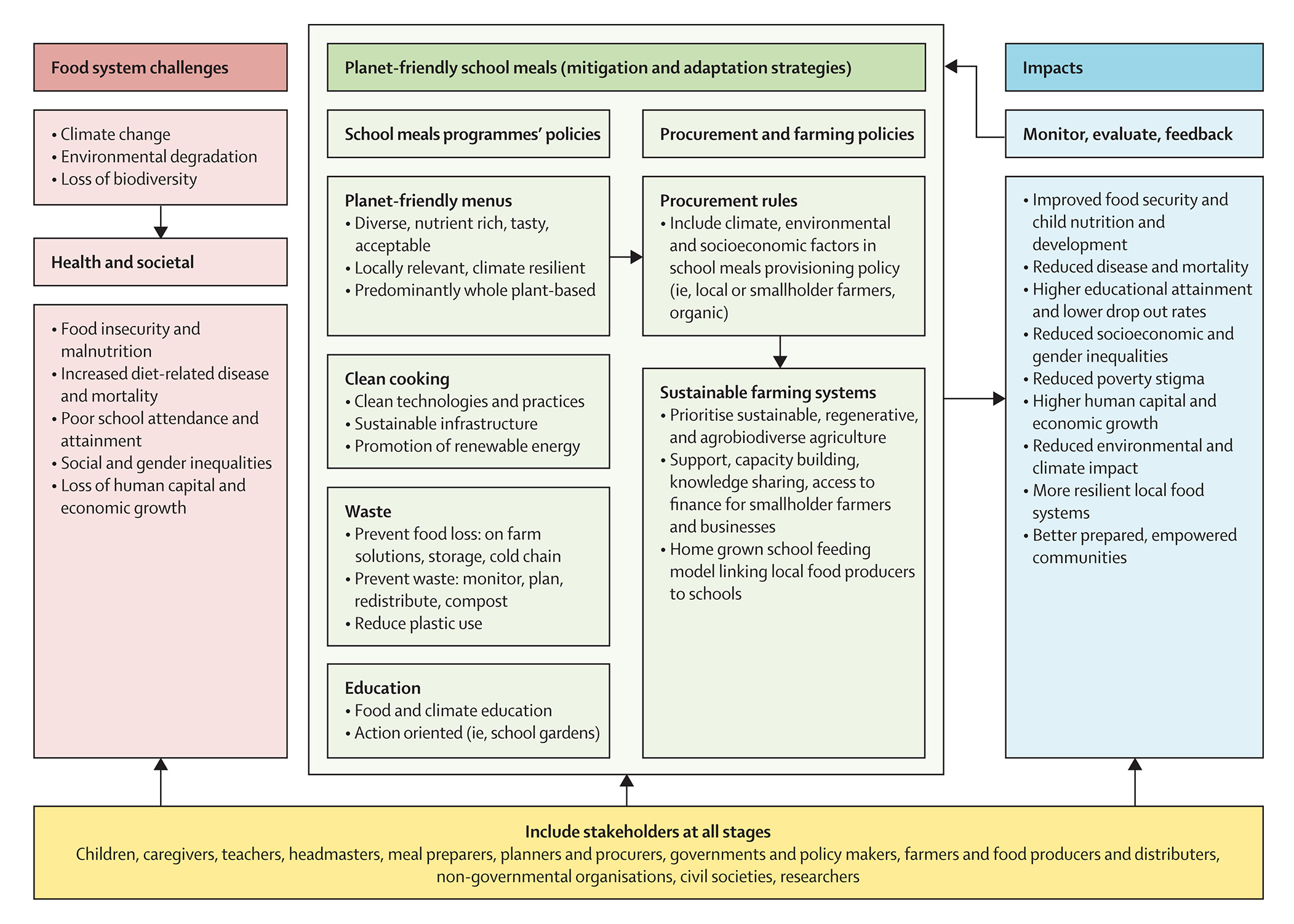
In a January 2024 report School Meals and Food Systems: Rethinking the consequences for climate, environment, biodiversity and food sovereignty, authors from the Research Consortium for School Health and Nutrition provide more detail about the recommendations offered in the conceptual framework above. They speak to how an investment in school food programs not only supports healthier children, but also that “action-oriented food education can empower future generations by fostering healthier and more sustainable food habits at a critical age when life-long dietary preferences and social attitudes are formed and carried into adulthood.” In other words, investing in intentional school food programs is an investment in a more sustainable future.
On pages 15-16, the authors go into more guidance for policy makers and communities. Their recommendations include (among many others):
- Establishing context-specific nutrition and food standards that integrate sustainability considerations
- Integrating sustainability aspects into the vocational training of chefs and kitchen personnel
- Using monitoring and planning tools to control orders and portion size and reduce food waste
- Reducing packaging and plastic waste
- Ensuring that holistic food education is a part of all school systems and available to all grades
- Recognizing that school food procurement offers huge potential for the policy level to have an entry point for local food systems transformation
- Ensuring that the regulatory framework relating to public procurement is aligned with sustainability objectives for school meals, and that instruments are in place to support the implementation of these objectives
- Prioritizing and setting targets for local procurement from small farms, and
- Giving preference to agricultural production systems that advance environmental sustainability.
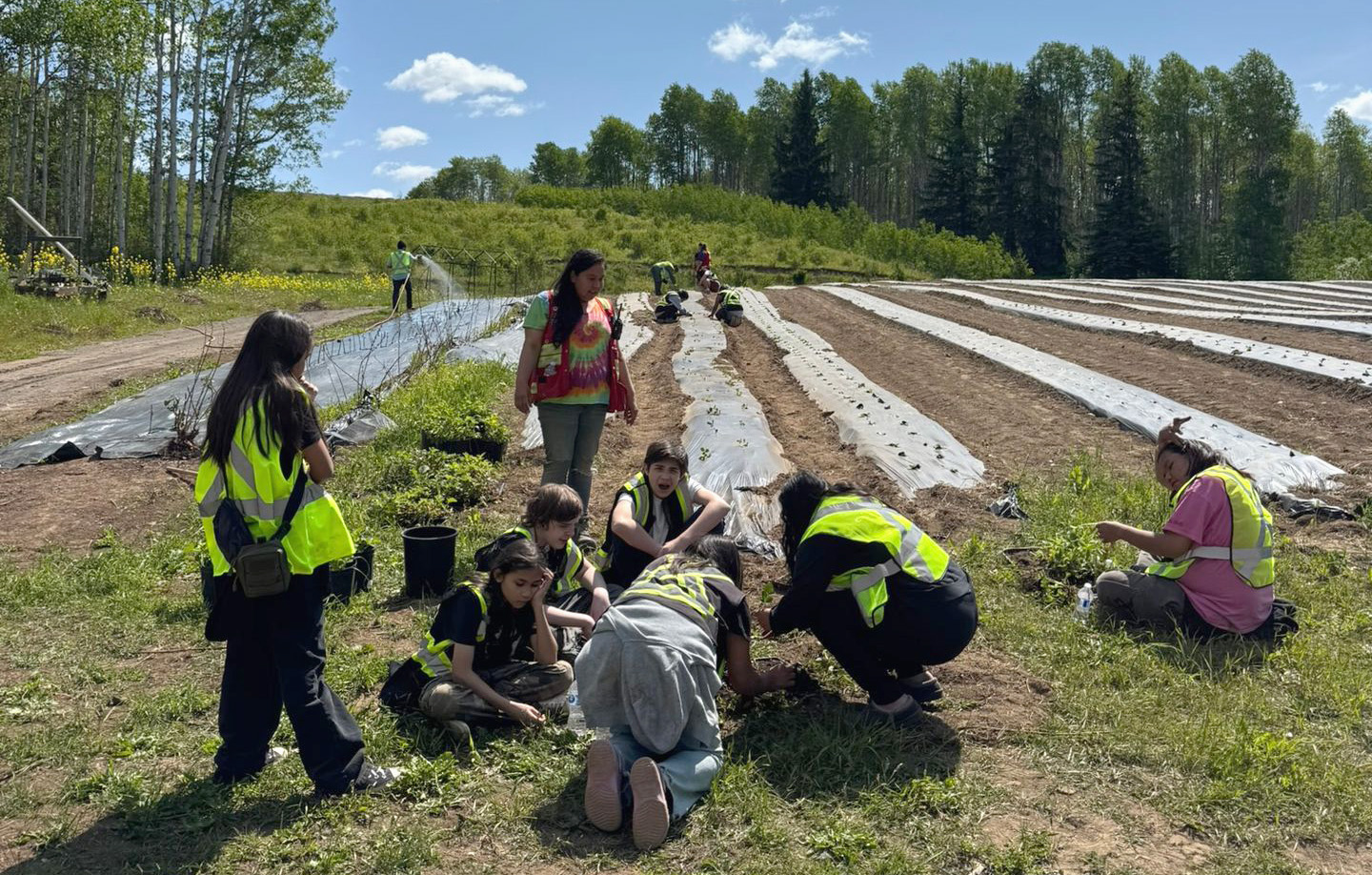
At Farm to Cafeteria Canada we’re proud to be the national leader in supporting schools and communities to advance the farm to school / local food to school approach across Canada. Our funding, resources and knowledge sharing opportunities help schools access more healthy local food at school, engage students in hands-on food literacy and connect students to their broader communities and food systems. Our Indigenous Foodways initiatives recognize the critical importance of Indigenous knowledges and practices, which are inherently sustainable and maintain the health and wellbeing of communities and the land and waters. Check out this article: Food sovereignty: An inclusive model for feeding the world and cooling the planet.
We deeply appreciate the emerging research that is showing us how we can all contribute to a healthier planet through our food systems.
Additional reading:
- Ecologically Sustainable Practices in School Food Programs: Considerations in a Canadian Context – a Masters Thesis written by University of Saskatchewan student Zoë Schipper.
- Transforming School Food Politics around the World – this book shares examples from Brazil, the United States, Canada, India, Finland, Japan, Peru, and South Korea and highlights how school food programs are a form of care for both humans and the environment. They highlight how, for example, South Korea is working to make their programs more eco-friendly by using preferential standards for sourcing school meals (trying to source meals with less pesticides) as well as how Brazil has used their school food program to drive local economic development for food produced in agro-ecological and environmentally sustainable ways. Access a podcast on this book here.
- The article Promoting environmental sustainability through school food procurement in low- and middle-income countries: critical reflections shares how “the lack of consensus on what exactly “environmentally sustainable food” is poses important challenges to the regulation and implementation of this policy objective through school food procurement”.
- Access The Rockefeller Foundation’s Regenerative School Meals project for more information about the potential for regenerative agriculture to be used with school meal programs.